Mrs. Dalton
Native SonMrs. Dalton is Mary Dalton’s blind mother and Mr. Dalton’s wife, a retired schoolteacher whose dependence on others’ descriptions becomes consequential after Mary’s death. She grieves for her missing daughter and appears in the investigation as both a bereaved parent and a witness unable to know exactly what happened in the bedroom. Through her, the novel joins intimate loss to the racial assumptions that shape what Bigger believes she can ask of him, what the public learns about the case, and whose death commands attention.
Identity and Household Position
At the inquest, Mrs. Dalton identifies herself as fifty-three years old, a retired schoolteacher, and the mother of Mary Dalton and wife of Mr. Dalton. She gives her residence as 4605 Drexel Boulevard, the family home where Bigger works. Her testimony also establishes Mary’s social and economic position: Mary was twenty-three, unmarried, insured for about thirty thousand dollars, and possessed real estate valued at approximately a quarter of a million dollars. These details make the family’s private bereavement part of a public investigation into the disappearance and death of a wealthy young woman.
Mrs. Dalton is blind, and the narration repeatedly makes that condition part of how other people encounter her. Her hands reach outward to find her husband, while she relies on voices and testimony to understand what has happened around her. The novel gives this dependence concrete consequences without making her blindness equivalent to ignorance in every respect: she can register distress in the household, but she cannot independently verify Mary’s last movements or recognize what occurred beside the bed.
Mary’s Disappearance and the Household Crisis
The first signs of trouble reach Mrs. Dalton through an account of Mary’s bed. When told that its cover had not been pulled back and that Mary apparently had lain down only briefly before getting up, she reacts with alarm and asks whether her daughter slept there. The exchange marks a change from uncertainty about Mary’s whereabouts to the recognition that her ordinary routine has been interrupted. Mrs. Dalton has no direct knowledge of what took place during the night; she must depend on what the household can observe and tell her.
Later, Bigger encounters her in a doorway. She denies that anything is wrong, although he understands that she is worried and wants to question him. He believes she will not ask him to explain Mary’s drunken condition because he is a Black servant and she is a wealthy white employer, and because, in his view, she would feel ashamed to discuss a family problem with him. That is Bigger’s interpretation of the racial and class distance between them, not an account of Mrs. Dalton stating such a rule. Her inability to see him does not remove the social barrier he expects to govern their conversation; instead, his confidence that she will not press him gives him room to leave without answering questions.
When the family learns that Mary has disappeared, Mrs. Dalton reaches for Mr. Dalton and grips his coat as she asks what has happened. Once he says that Mary has been kidnapped, she cries for her daughter. The announcement supplies an explanation the family can act upon, but it is false: Bigger has concealed Mary’s death and is using the presumed kidnapping to pursue a ransom. Mrs. Dalton’s grief is genuine, while the story she receives about its cause is part of Bigger’s deception.
Public Appeal and Testimony
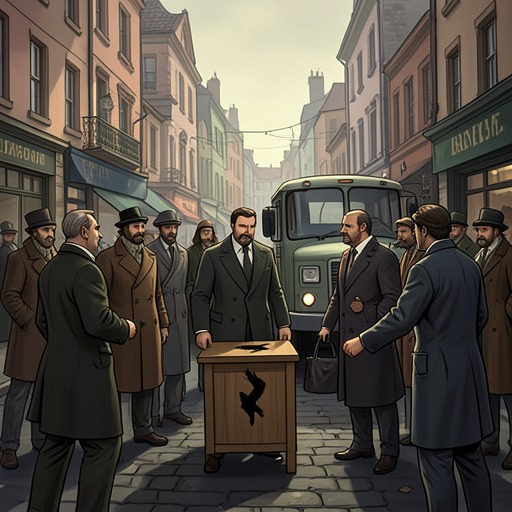
During the press gathering in the basement, Mrs. Dalton descends the stairs behind Mr. Dalton, moving quietly with one hand on the banister and the other held out. The family’s large white cat follows her and leaps onto Bigger’s shoulder. He fears that the animal has exposed him as Mary’s killer, but its behavior does not identify him to the reporters; the cameras instead record an image in which he stands near the grieving household. Mr. Dalton tells the reporters that he has asked for Jan Erlone to be released and that he has no charge to bring against him. Mrs. Dalton’s presence beside her husband makes her part of this appeal, although the statements are Mr. Dalton’s and the evidence does not assign her a separate public declaration at that moment.
The reporters arrange another image of the couple on the basement steps, with Mr. Dalton holding the ransom letter and Mrs. Dalton extending a hand. The pose turns their loss into a public appeal for Mary’s return. Bigger watches the cameras and worries that the photographs will make him recognizable. For him, the scene is not simply a display of the family’s distress: it is also a changing practical danger, as the images may narrow his chance of escaping detection. Mrs. Dalton does not know what he knows, and the camera records the family without revealing the crucial difference between its stated hope and the concealed death.
At the inquest, Mrs. Dalton is sworn in and answers questions about her identity, her family, and Mary. Asked whether she could have failed to know or suspect that Mary was already dead, she says she does not know. The answer underscores the limits of what she can establish as a witness: she can report what she did and what she believed, but cannot supply certainty about Mary’s condition at the time. Asked about the last thing she did while standing above her daughter’s bed that Sunday morning, she says that she knelt and prayed. Her testimony brings the private scene of a mother at her daughter’s bedside into the formal proceedings, while leaving the essential facts of the death outside her knowledge.
Grief, Race, and the Meaning of the Case
Mrs. Dalton also appears when Bigger’s mother kneels before her and pleads for her son’s life, invoking their shared experience as mothers and the family’s dependence on the Daltons’ house. Mrs. Dalton asks what the distressed woman wants, but the account does not say that she grants or refuses the plea. The encounter places two mothers within the same institutional crisis but on sharply unequal terms: one family has wealth and public standing, while the other faces poverty, threatened displacement, and the possibility that its son will be killed.
During the inquest, Bigger sees Mrs. Dalton seated beside Mr. Dalton and remembers the bedroom scene in which she had entered while he was holding a pillow over Mary’s face. The remembrance connects her earlier inability to see with his terror that she might discover him. Yet her role in the case is not reducible to that plot function. Her testimony and grief establish her as a bereaved person, even as the proceedings place the family’s loss within a larger racial conflict.
Max’s defense later argues that Mary had been conditioned to regard Bigger as a kind of beast and that Bigger had been commanded, under threat of death, to avoid her. This is Max’s argument about the social conditions that shaped the encounter, not a statement by Mrs. Dalton about her own beliefs. The distinction matters: her expressed answer at the inquest is that she bears no ill will toward Black people, but that declaration alone does not settle the broader conditions of racial separation Max identifies. The novel sets a personal profession of goodwill beside a society in which contact between Mary and Bigger is constrained and misread.
Narrative and Critical Significance
Mrs. Dalton’s blindness works in the plot through specific limits on perception: she cannot see who is present, must reach for familiar people, and cannot independently establish what happened in Mary’s room. At the same time, Bigger’s response to her condition is shaped by his own fear and by his understanding of the racial distance between employer and servant. The difference between what she can know and what he assumes she will ask allows suspense to accumulate without making her responsible for his concealment.
Richard Wright later explained that he knowingly placed an unusually large group of people together in Bigger’s cell, including Mrs. Dalton, because their presence elicited an emotional response that mattered more to him than the scene’s surface plausibility. He described his method as rendering both the objective and subjective dimensions of Bigger’s life and, when necessary, shifting among interior thought, direct action, and other people’s accounts of Bigger. Mrs. Dalton’s part in the wider narrative thus belongs to a design that repeatedly brings private experience into contact with public judgment. Her grief is not the final measure of the case: the proceedings and Max’s argument show how the meaning assigned to Mary’s death is shaped by race, wealth, and the unequal value placed on different lives.